Advanced Electrolysis
Sterex SX-T Thermolysis
Electrolysis (Thermolysis) is a method of permanent hair removal that uses a thin probe inserted into the hair follicle to deliver an electric current, destroying the hair growth cells. A high frequency alternating current generates heat which disables the follicles’ ability to produce hair. Multiple sessions are required to effectively treat hair in different growth cycles. (growth, rest, shedding)
The process is often described as feeling a slight sting or moderate heat. In rare cases a patient might experience some swelling. It is advised not to touch the treated area and to avoid make up for 24 hours to avoid a secondary infection.
Advanced electrolysis
With advanced electrolysis some wound healing is involved. Epithelial cells are replaced within 3 days by division and upward migration of cells. Wound healing also depends on the health of the skin barrier, age of the patient and homecare.
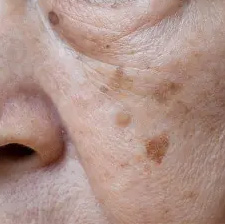
Age spots
Age spots are also known as solar lentigo, liver spots, sum spots or brown spots. It’s a change in skin colour associated with older skin. They are harmless discolorations which usually appear on the back of hands, neck and face and are a sign of sun damage.
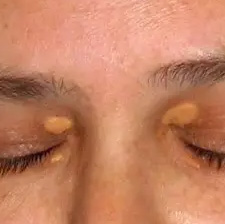
Xanthelasma
Xanthelasma palpebrarum are yellowish cholesterol deposits under the skin, usually on or around the eyelids. The exact cause is unknown, but it is indicative of a lipid metabolism disturbance. It is typically associated with an increased cholesterol level.
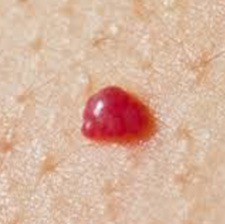
Blood spots
Also known as Cherry angiomas and when larger and raised can be referred to as Cambell de Morgan spots. They are completely harmless and can vary in size from very small to where they are raised in a dome shaped lump. Typically, these bloodspots are not painful, though can be prone to bleeding as the blood is very near the surface of the skin if scratched or caught in a zip or necklace etc.
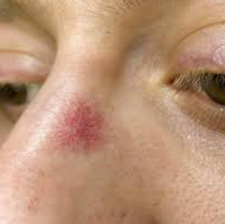
Red veins/ Spider naevi
Facial red veins is a form of Telangiectasia or vascular blemish which can successfully be treated with advanced electrolysis. Most cases of facial veins are a direct result of an externally caused trauma to the skin, such as excessive blowing of the nose, picking, a knock or a bump, over exposure to sun, extreme temperatures (hot & cold) or anything that causes pressure on vessels.
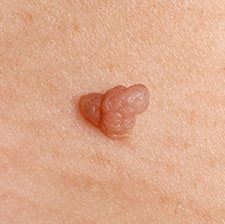
Skin tags
Skin tags are a common fibrous skin condition which develop as raised growths, often appearing to “hang” off the epidermis. They are benign but can be unsightly to those who have them. Skintags primarily occur in areas of friction such as under the breasts and axillae, and other areas where the skin forms folds and creases such as the neck.
They can occur on the face, particularly the orbital region, in the creases of the eye and on the eyelid itself.
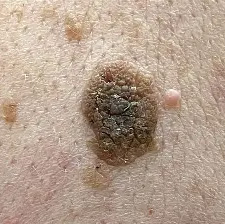
Seborrhoeic keratosis/ Dermatosa Papulosa Nigra
Seborrhoeic keratosis can affect any skin type and ethnicity however, on dark-skinned people these blemishes can also appear as multiple small dark brown or black bumps, especially on the face and neck. In such case this is called Dermatosa Papulosa Nigra.
Seborrhoeic keratosis has a rough waxy surface and range in colour from light golden brown to mid- brown to almost black due to the presence of melanin.
Cause is unknown; however, it has been suggested that exposure to sunlight might be a cause. Other than that, the most recognised reason for their appearance is during the natural aging process on skins that have a predisposition to this type of growth.
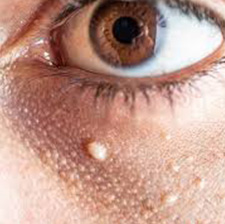
Milia
The exact causes of Milia are unknown, but it is understood that sebum and keratinocytes are compressed beneath the surface of the skin within a blind duct. Milia tends to occur in clients with dry skin, likely due to the dehydrated state, or a build up of excess skin cells that then trap sebum. Milia is also linked with the use of products on the face that are too rich, strong, abrasive or simply unsuitable for that skin type.
Some research suggests that an extreme lack of sun exposure can contribute to Milia formation. Sunscreens that are generally acknowledged as non-comedogenic would suggest that their use may be of benefit of the protection of all vulnerable skin types.
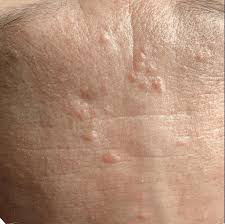
Syringoma
Syringoma are harmless eccrine sweat duct tumours. They are non-contagious, flesh coloured elevations of the skin. Normally they are found in clusters around the eyes but can also be elsewhere on the face. They can be hereditary, more common in woman than men. They usually develop in a skin with an oily complexion, and often also found on a skin in a hot, moist environment.
Sebaceous hyperplasia
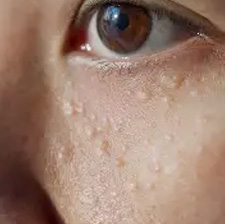
Sebaceous hyperplasia is a very common, benign condition of sebaceous glands in adults. It’s a creamy yellowish papule, almost in donut shape. They will appear as enlarged mature sebaceous glands that surround a dilated sebaceous duct.
Causes often arise from swollen hair follicles. They can also develop when an oil duct is deformed or damaged due to trauma in the area. (injury, acne).
Aging also plays a role as the production of sebum, and the rate of cellular production slows down.